

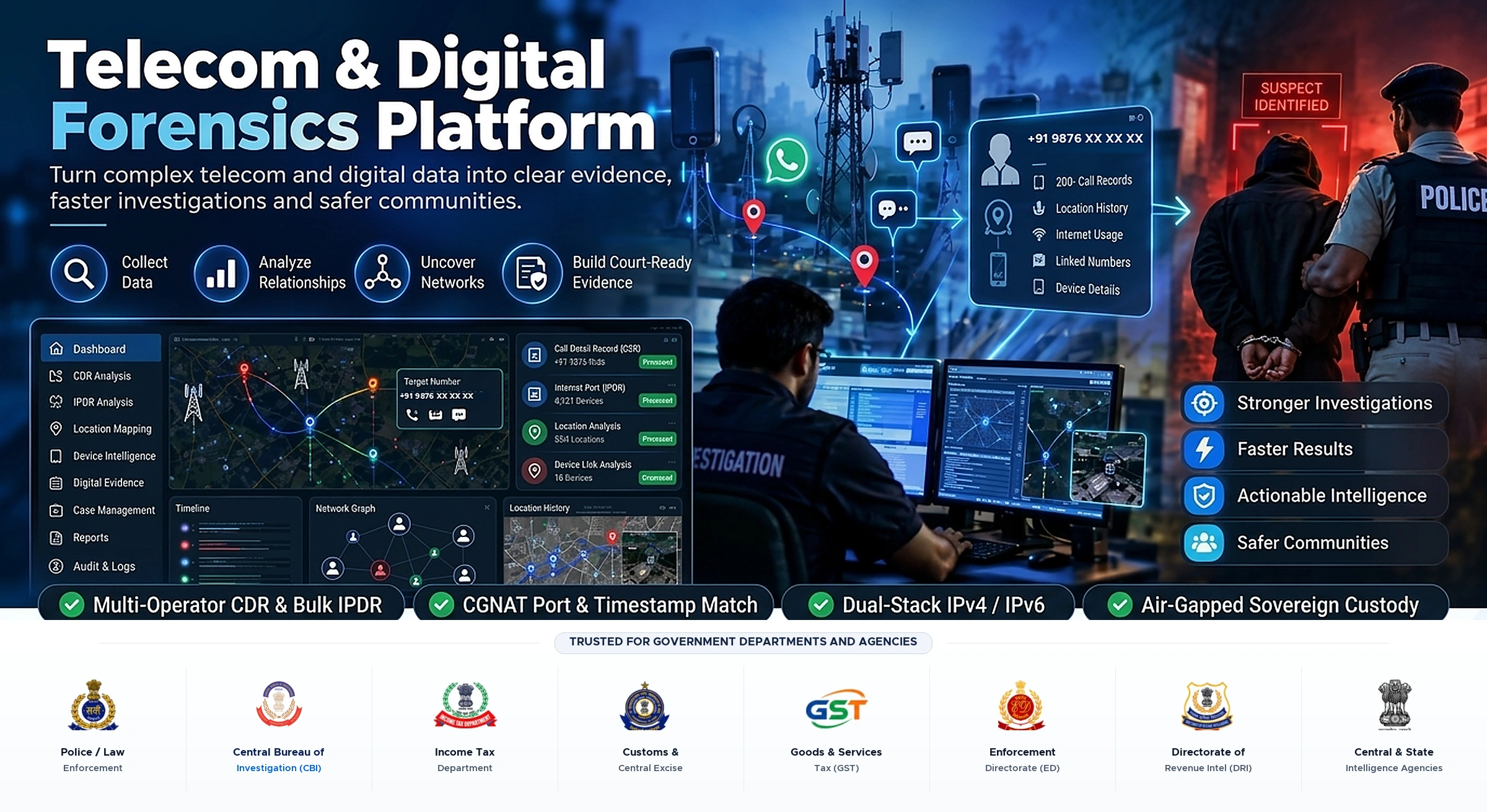
Designed for authorized government departments and institutional investigative functions handling telecom, digital and network forensic data. Ingest and correlate multi-operator CDR, high-volume IPDR, Carrier-Grade NAT (CGNAT) allocations, device identifiers, and seized network logs into a unified chronological timeline.
Traditional Call Detail Record (CDR) analysis alone is no longer sufficient when suspects communicate across mobile data sessions, Carrier-Grade NAT (CGNAT), and dynamic network endpoints. Prodaaps brings cellular telephony, IPDR sessions, and seized network logs into one verified investigative framework.
A specialized, on-premise telecommunications and digital communication forensic software suite designed to ingest, clean, normalize, correlate, and timeline multi-carrier cellular and packet-switched records.
Authorized government departments, law enforcement agencies, cyber crime cells, financial intelligence & anti-fraud units, tax & regulatory authorities, and digital forensic examiners.
Bridges the investigative gap between cellular calls and mobile data — correlating dynamic IP sessions, CGNAT translation logs, multi-SIM swapping, tower movements, and seized router syslog events.
Suspects operate across multiple communication layers. Prodaaps provides a structured ingestion and correlation engine that synchronizes cellular, internet protocol, and local network records.
Multi-carrier ingestion of voice calls, SMS, roaming, IMEI/IMSI pairs, and operator-provided tower location records across standard formats.
High-throughput ingestion of packet-switched mobile data records with automated dual-stack IPv4 and IPv6 canonical normalization.
Systematically correlates Carrier-Grade NAT (CGNAT) allocations by matching Public IP, source port, and exact microsecond timestamps against TSP translation logs.
Ingests DHCP lease tables, hotspot syslogs, and local gateway connection logs from seized routers to correlate physical MAC addresses with cellular activity.
Organized into six logical functional groups built around the practical operational workflow of an investigative cell.
High-throughput ingestion engine for multi-operator CDR, high-volume IPDR, and network logs with automated column mapping and intake hashing.
Identify covert associations and communication patterns using association matrices, common contact identification, and call frequency analysis.
Map cell tower IDs from operator records to coordinates and azimuth angles to analyze suspect movement corridors and determine tower coverage zones.
Chronologically fuses cellular calls, SMS messages, dynamic IPDR data sessions, and local Wi-Fi events into a single unified investigation timeline.
Cross-references physical hardware (IMEI 1/2, MAC) against subscriber identities (IMSI, MSISDN) and dynamic IP sessions to trace suspect devices.
Generates structured investigation dossiers with source origin tracking, chained audit logging, and formats structured to support Section 65B Indian Evidence Act submissions.
Modern cybercriminals rely heavily on OTT messaging applications. Prodaaps establishes strict evidentiary clarity: we correlate lawful network metadata without making unscientific claims of payload decryption.
End-to-End Encrypted (E2EE) protocols utilize client-side public-key cryptography. Carrier-provided records and telecom data do not contain plaintext payload data:
By ingesting lawful IPDR logs, CGNAT translation records, and seized local network dumps, Prodaaps builds structured, multi-source metadata corroboration:
A four-stage analytical pipeline engineered for fast operational turnaround.
Ingest multi-carrier CDR, high-volume IPDR (IPv4/IPv6), and seized Wi-Fi/router syslogs with automated layout alignment, timestamp normalization, and intake SHA-256 hashing.
Correlates dynamic IP sessions via CGNAT public IP + source port + microsecond timestamps. Matches IMEIs to IMSIs, resolves tower cell IDs, and links seized router MAC addresses.
Synchronizes cellular calls, packet-switched IPDR sessions, and Wi-Fi events into a unified chronological sequence to track suspect activity patterns and cross-channel event order.
Generates comprehensive analytical case dossiers structured to support Section 65B Indian Evidence Act submissions, backed by cryptographic chained audit logs and verification hashes.
Preview of analytical investigation consoles for querying records, reviewing contact relationships, and inspecting movement corridors from processed case files.


Designed to deliver rapid clarity in complex, time-sensitive investigations across government departments, police cells, and regulatory bodies.
Rapidly isolate newly introduced numbers contacting a victim's family, trace associated cell towers, and detect burner handset switching via IMEI/IMSI pair transitions.
Correlate cellular voice records with concurrent OTT app sessions and tower movements across dozens of seized devices to separate ground operatives from handlers.
Ingest banking server logs, correlate public IP and source port at the exact microsecond against carrier CGNAT logs, and isolate the subscriber MSISDN/IMSI.
Intersect raw cellular tower dumps and seized router Wi-Fi/DHCP logs from multiple incident scenes to isolate common active devices present across critical time windows.
Engineered to conform with strict sovereign security mandates and internal chain-of-custody protocols.
Deploy directly onto standalone forensic workstations with zero external internet connectivity required. All parsing, correlation, classification, and timeline fusion execute entirely offline.
Install on a secure department intranet server to allow multiple authorized analysts to collaborate on shared case repositories with role-based access permissions.
All case databases and processed files remain stored locally within your department network or workstation environment.
Common questions regarding format compatibility, deployment, and onboarding.
Schedule an executive briefing and software walkthrough with our team. We assist with on-premise evaluation and technical specifications.